Smeaton’s Spirits Academy 1
The Spirits Academy responds to requests for articles discussing spirits in detail.
This first article covers the processes of fermentation and distillation and their role in transforming raw ingredients in to spirits.
Every spirit begins with something remarkably simple. An ingredient, such as grain; grapes; sugar cane; agave or fruit.
But before these ingredients can become whisky, brandy, rum, tequila or gin, they must undergo a sequence of transformations.
Conversion makes fermentable sugars available. Fermentation creates alcohol. Distillation concentrates, separates and refines the resulting liquid.
Each stage matters. And the choices made at each stage help determine the character of the spirit that eventually reaches the glass.
Conversion makes fermentable sugars available from raw materials such as grain and agave.
Fermentation uses yeast to convert those sugars principally into ethanol and carbon dioxide, while also creating many other compounds that can contribute to flavour.
Distillation uses differences in volatility to concentrate ethanol and separate it from water and other compounds.
Rectification increases the degree of separation and can produce a highly purified, relatively neutral spirit.
And one principle runs through them all - the character of a spirit depends not only on what is used, but on how it is treated.
1. Conversion: making the raw material fermentable
The first requirement for fermentation is sugar. Yeast needs fermentable sugar to produce alcohol. But many of the raw materials used to make spirits do not initially contain sugar in a form that yeast can readily use.
Grain is the obvious example. Barley, wheat, rye and corn contain substantial quantities of starch, rather than simple fermentable sugars. The starch therefore has to be converted.
In traditional whisky production, barley may first be malted. Germination activates enzymes in the grain, and during mashing those enzymes help break the starch down into simpler sugars. Other grains can be converted using enzymes during mashing.
Agave follows a different route. Its carbohydrates must first be converted into fermentable sugars, traditionally through cooking or roasting.
Grapes, sugar cane and molasses already contain significant quantities of fermentable sugar and therefore do not require the same form of starch conversion.
The principle, however, is the same: Conversion prepares the raw material for fermentation. It is the first transformation in the journey from agriculture to spirit.
2. Fermentation: where alcohol begins
Once fermentable sugars are available, yeast can begin its work. Fermentation is the biological process in which yeast converts sugars principally into ethanol and carbon dioxide.
A simplified representation is:
Sugar → ethanol + carbon dioxide + other compounds
The words principally and the other compounds matter. Fermentation does not produce pure ethanol. It produces a complex mixture containing ethanol, water, acids, esters, aldehydes, higher alcohols and many other compounds.
Some contribute desirable aroma and flavour. Others may be undesirable, particularly at excessive concentrations.
The character of the eventual spirit therefore begins before the still is used. The raw material, yeast, temperature, duration and conditions of fermentation can all influence the resulting fermented liquid.
This is why fermentation is not merely a way of producing alcohol. It is the first stage of flavour creation.
3. Ethanol: the alcohol the distiller wants
The principal alcohol in a distilled spirit is ethanol, also known as ethyl alcohol.
It is ethanol that provides the characteristic alcoholic strength of whisky, brandy, rum, vodka and gin. But ethanol is only one component of the fermented liquid.
Other alcohols can also be present. Methanol, for example, can be produced during fermentation, particularly from pectin-rich plant material. Because of its toxicity, methanol concentration in finished spirits is subject to strict regulatory limits.
There are also higher alcohols, sometimes called fusel alcohols, including compounds such as propanol, butanol and amyl alcohols. Some of these higher alcohols can contribute complexity and character at appropriate concentrations. In excessive concentrations, however, they can produce undesirable aromas and flavours.
The distiller's objective is therefore not simply to remove every substance except ethanol. It is to control the composition of the final spirit.
That involves the management of fermentation, the design and operation of the still, and careful separation of the distillate.
4. Distillation: concentration and separation
The fermented liquid contains relatively little alcohol compared with the finished spirit. Distillation transforms it. The liquid is heated in a still. Volatile components enter the vapour phase, and that vapour is subsequently cooled and condensed back into liquid.
The resulting distillate contains a much higher concentration of ethanol. But distillation is not simply "boiling off the alcohol". Nor is it a straightforward process in which every substance leaves the still at its precise boiling point.
A fermented liquid is a complex mixture. Alcohols, water and flavour compounds interact with one another, and their behaviour depends upon the composition of the liquid and vapour, the design of the still and the conditions of the distillation.
This is why distillation is both a science and a craft. The distiller is managing concentration, separation and selection.
5. Heads and Tails
As a distillation progresses, the composition of the distillate changes. Distillers commonly describe three broad portions:
Heads
The early portion of the distillation contains a greater concentration of some highly volatile compounds.
Depending on the spirit and the process, some of these compounds are undesirable in the finished product and the relevant fraction may be discarded or redirected.
Hearts
The hearts contain the portion of the distillation selected for the finished spirit. They generally offer the desired balance between ethanol and flavour compounds.
Tails
Towards the end of the distillation, the composition changes again, with increasing concentrations of less volatile compounds and higher-boiling components. The boundaries between these fractions are not fixed. They depend upon the raw material, the still, the distillation conditions and the character the distiller is trying to achieve.
This is an important point. The distiller is not simply looking for the fraction containing the greatest possible concentration of ethanol. The objective is to select the right composition for the spirit.
6. Rectification
Rectification is the repeated separation of volatile components during distillation, allowing the distiller to increase the concentration of ethanol while reducing or controlling other compounds.
It is particularly associated with column stills. A column contains a series of stages in which rising vapour and descending liquid interact. This creates repeated opportunities for more volatile components to move upwards and less volatile components to move downwards.
The result can be a spirit with very high alcoholic strength and a high degree of neutrality. This is especially useful when the distiller wants a clean agricultural spirit as a starting point.
Vodka is an obvious example. So is much of the neutral spirit used as the base for gin. But rectification should not be confused with quality. A highly rectified spirit is not automatically a better spirit - rather it is a different starting point.
The appropriate degree of rectification depends upon what the distiller wants the finished spirit to express.
7. Stills
Two broad types of still dominate spirits production.
Pot still
Operation: Batch by batch.
How it works: A charge of fermented liquid is heated and distilled as a single batch.
Typical strength: Depends on the spirit and the distillation process.
Degree of rectification: Generally more limited.
Typical objective: Often to retain more character from the fermented material.
Examples: Scotch malt whisky, Cognac and Armagnac.
Key characteristic: Batch control and the potential to retain distinctive character.
Column still
Operation: Continuous.
How it works: Vapour and liquid repeatedly interact within the column, providing multiple stages of separation.
Typical strength: Can produce very high-strength spirit.
Degree of rectification: Can be very high.
Typical objective: Often to achieve greater concentration, separation and neutrality.
Examples: Neutral agricultural spirit and many styles of rum.
Key characteristic: Efficient separation and rectification.
Neither method is "better". They are different instruments designed to achieve different objectives. So the more interesting question centres on intent - what is the distiller aiming to achieve? That question becomes particularly important when the material being distilled is not a fermented wash, but botanicals.
8. Copper, Heat and Time
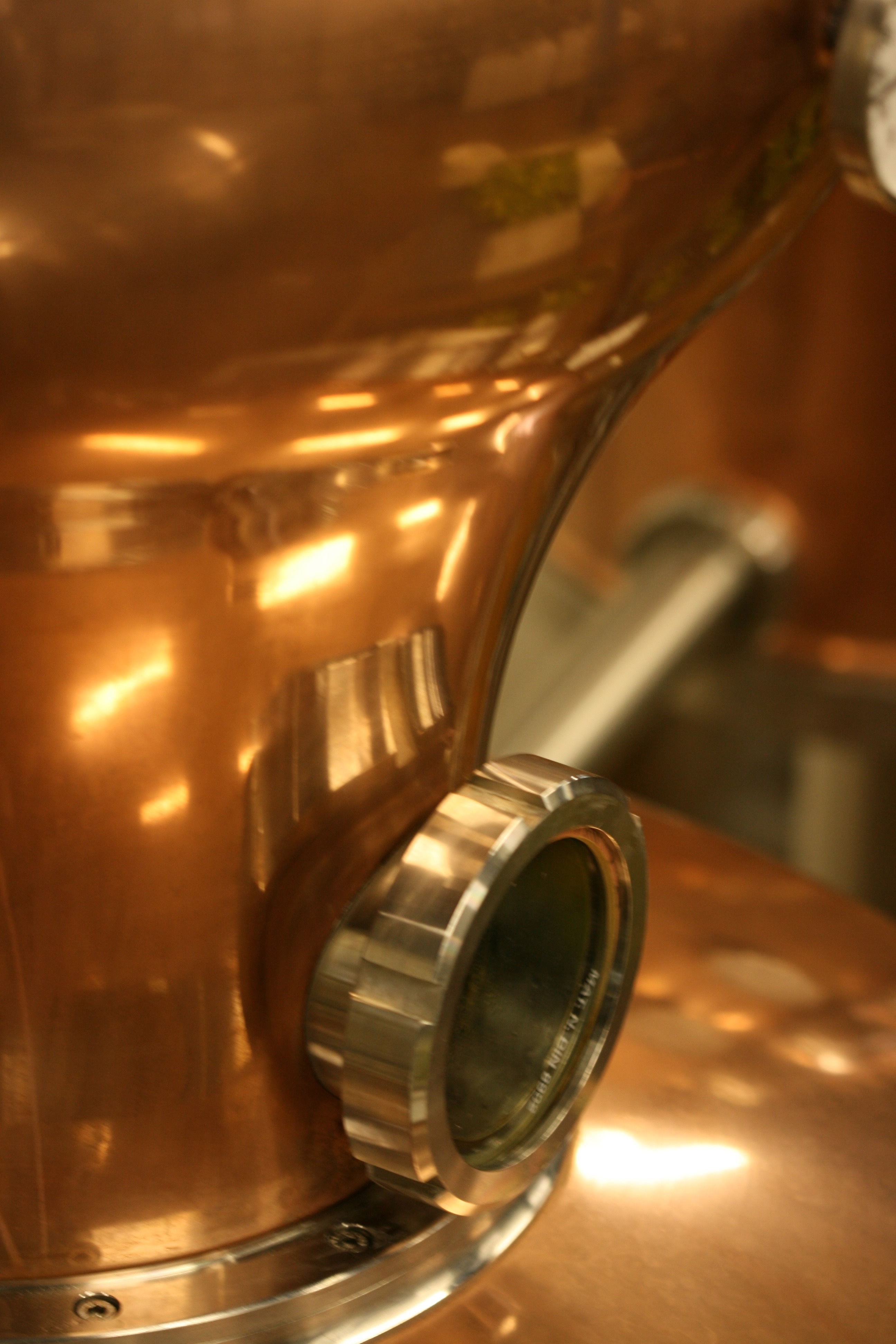
Many traditional stills are made from copper.
One important reason is copper's ability to react with certain sulphur-containing compounds produced during fermentation, helping to reduce undesirable sulphurous aromas.
But the still's influence extends beyond its material. Its shape and size, the way it is heated, the rate at which the distillation proceeds and the design of the condenser can all influence which compounds are carried through into the distillate.
Heat matters. Time matters. The rate of distillation matters. And the way cuts are made matters. The still is not merely a vessel in which alcohol is boiled. It is part of the recipe.
9. From distilling alcohol to distilling botanicals
This is where gin introduces a fascinating new dimension.
The agricultural-origin alcohol used as the base for many gins has already been highly rectified. The distiller now has a different challenge.
Rather than preserving the flavour of a fermented raw material, the objective is to create a new flavour composition from botanicals. Juniper is fundamental. But it can be accompanied by citrus, coriander, roots, seeds, spices, flowers and herbs.
And those ingredients are not chemically or physically identical. A root behaves differently from a flower. A fresh orange behaves differently from a dried spice. Juniper behaves differently from both.
So the method used to extract and distil those ingredients matters.
10. One Process or Individual Treatment?
In many traditional and contemporary gin-making processes, several botanicals are distilled together. This can be highly effective. But it creates an inherent constraint: the botanicals share the same distillation environment.
They are exposed to the same general conditions of maceration, heat, vapour flow and distillation. That can be appropriate when the desired result is an integrated botanical profile created in a single distillation. But it also means that the distiller has less opportunity to optimise the process for each individual ingredient.
This is the central technical proposition behind individual botanical distillation.
When botanicals are distilled separately, each can be treated according to its own characteristics. Maceration can vary. Heat and distillation conditions can vary. The rate of distillation can vary. Cuts can vary. The resulting distillates can then be assessed and blended. The result is not simply greater complexity. It is greater control over composition.
And this approach, of separate distillations, is rooted in the history of trading ports which received fresh produce at different times of the year.
11. The botanical compromise
Consider two very different ingredients. A fresh citrus fruit contains delicate aromatic compounds that contribute brightness and lift. A dense root may require quite different treatment to extract its desired characteristics. A spice may behave differently again. If all three are treated together, the distiller has to establish one overall process for the botanical charge.
That does not mean that the result will be poor. It means that the process has to accommodate the requirements of different ingredients within one distillation.
Individual botanical distillation changes that equation. Each ingredient can be approached on its own terms. The distiller can determine an appropriate maceration, distillation regime and cut for that particular botanical, then blend the resulting distillates afterwards. This is the mechanical basis for the argument that individual botanical distillation can offer greater precision and control over botanical expression.
It is not a claim that a single combined distillation cannot produce an excellent gin. It is a claim about the additional control available when the ingredients are treated individually.
12. The Bristol Method
The Bristol Method refers to a documented historical approach to gin-making in which botanicals are individually distilled rather than being treated as one botanical charge.
Smeaton’s recreates a handwritten 1870s gin recipe discovered in the historic Bristol Archives on Smeaton Road. This original recipe calls for fresh botanicals to be individually distilled in traditional copper pots according to their season.
The historical provenance gives the method a particularly tangible quality. It is not simply a modern name invented to describe a contemporary gin-making technique. Rather, Smeaton’s is a proud and considered revival of a historical Bristol approach to botanical distillation.
And its significance lies in the degree of control that individual distillation provides. Different ingredients can be treated according to their individual characteristics, rather than requiring one common process for the entire botanical charge. That is a compelling technical proposition as well as a time-proven philosophy of production.
13. Why individual botanical distillation can matter
The distinction can be expressed simply.
Combined botanical distillation
Many botanicals → one distillation environment → one overall process → integrated flavour
Individual botanical distillation
Each botanical → its own bespoke distillation → individual distillates → blending and composition → resting and integration → integrated and complex pure flavour
The second approach is considerably more labour-intensive. But it provides another degree of freedom. The distiller can decide how each botanical should be treated and then decide how much of its resulting distillate belongs in the finished composition. It's a different kind of craftsmanship. The distiller is no longer simply managing a recipe. The distiller is composing from individual distillates.
14. From chemistry to craft
The journey from raw ingredient to finished spirit can now be seen as a series of deliberate transformations.
Raw material
What happens: Grain, fruit, sugar cane, agave and other agricultural materials provide the starting point.
Principal purpose: To supply carbohydrates and, in some cases, flavour precursors.
Conversion
What happens: Starch or other complex carbohydrates are converted into fermentable sugars.
Principal purpose: To make the material available to yeast.
Fermentation
What happens: Yeast converts sugars principally into ethanol and carbon dioxide.
Principal purpose: To create alcohol and fermentation-derived compounds.
Distillation
What happens: Volatile compounds are concentrated and separated through evaporation and condensation.
Principal purpose: To increase alcohol strength and shape the composition of the spirit.
Rectification
What happens: Repeated vapour-liquid separation increases ethanol concentration and controls other volatile compounds.
Principal purpose: To produce a cleaner or more neutral spirit where desired.
Botanical distillation
What happens: Botanicals are extracted and/or distilled in the presence of agricultural-origin alcohol.
Principal purpose: To create the characteristic flavour and aroma of gin.
Individual botanical distillation
What happens: Botanicals are distilled separately and the resulting distillates are subsequently blended.
Principal purpose: To give the distiller greater control over the character and contribution of each individual botanical.
It's therefore apparent that a spirit is never simply the product of its ingredients. It is the product of what is done to those ingredients. The raw material matters. The conversion matters. The fermentation matters. The still matters. The distillation conditions matter. The decisions about what to retain and what to reject matter. And, for gin, the treatment of each botanical can matter enormously. This is where science becomes craft. And where a recipe becomes a composition.
Frequently Asked Questions
What is conversion in spirits production?
Conversion is the process of making carbohydrates such as starch available as fermentable sugars. It is particularly important for raw materials such as grain and agave, which do not initially provide yeast with sufficient readily fermentable sugar.
What happens during fermentation?
Yeast converts fermentable sugars principally into ethanol and carbon dioxide, while also producing a range of other compounds that can contribute to the aroma and flavour of the eventual spirit.
What is the desired alcohol in spirits?
Ethanol, or ethyl alcohol, is the principal alcohol sought in the production of distilled spirits. Fermentation also produces other alcohols and compounds, which are managed during production and distillation.
What other alcohols are produced during fermentation?
Fermentation can produce methanol and higher alcohols such as propanol, butanol and amyl alcohols. Some higher alcohols can contribute flavour and complexity in appropriate concentrations, while excessive concentrations can be undesirable. Methanol is subject to regulatory limits because of its toxicity.
What does distillation do?
Distillation uses differences in volatility to concentrate ethanol and separate it from water and other compounds. It is not simply a process of boiling alcohol away from water; the behaviour of the components depends on the composition of the mixture and the conditions of distillation.
What is rectification?
Rectification is repeated separation during distillation that can increase the concentration of ethanol while reducing or controlling other volatile compounds. It is particularly associated with column distillation and is important when a highly neutral spirit is required.
What is the difference between a pot still and a column still?
A pot still operates batch by batch, whereas a column still allows repeated vapour-liquid contact and can achieve a much higher degree of rectification. Pot stills are often used where retaining character is important; column stills are particularly useful where high strength and neutrality are desired.
Why does distillation affect flavour?
Because distillation does more than concentrate ethanol. It also separates and selects volatile compounds. The design of the still, heat input, distillation rate and the distiller's selection of fractions all influence which compounds remain in the finished spirit.
What is gin?
Under the EU definition, gin is a juniper-flavoured spirit drink produced by flavouring agricultural-origin ethyl alcohol with juniper berries. Its minimum alcoholic strength is 37.5% ABV and its taste must be predominantly that of juniper.
What is distilled gin?
Distilled gin is a defined category produced through the distillation of agricultural-origin ethyl alcohol in the presence of juniper and other natural botanicals, subject to specified conditions. Simply adding flavourings to agricultural-origin ethyl alcohol does not make a spirit "distilled gin".
What is the Bristol Method?
The Bristol Method is a historical gin-making approach in which individual botanicals are distilled separately, allowing their treatment to be varied according to their individual characteristics before the resulting distillates are blended. Smeaton’s states that its gin recreates a handwritten 1870s recipe discovered in the Bristol Archives.
Why can individual botanical distillation offer an advantage?
Different botanicals respond differently to alcohol, maceration, heat and distillation. Treating them separately allows the distiller greater control over the process applied to each ingredient and over the proportion of each resulting distillate used in the finished gin.
The journey continues...
We have seen how agricultural ingredients become alcohol, how fermentation creates the first generation of flavour, and how distillation concentrates and selects what ultimately reaches the glass.
But different spirits take these principles in very different directions.
Whisky finds character in grain, fermentation, distillation and time in oak.
Brandy carries the character of fruit through fermentation and distillation.
Rum begins with sugar cane.
Agave spirits express the character of the plant and the traditions used to transform it.
Vodka pursues neutrality and mouth feel.
And gin takes a highly rectified agricultural spirit and turns it into something quite different: a composition of juniper and botanicals.
That is where our exploration continues.
Next: What Is Gin? From Neutral Spirit to Botanical Character.
Smeaton’s Spirits Academy explores the Beauty of Bespoke and the ingredients, techniques and decisions that shape the world's great spirits.